

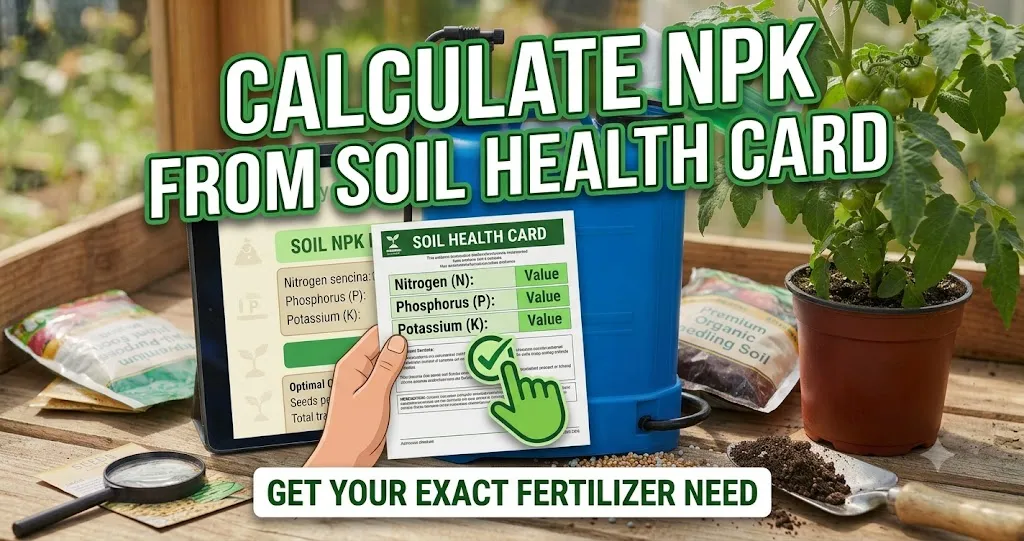
How to Calculate NPK Requirement from Your Soil Health Card
Your Soil Health Card has the numbers – here's how to read them, turn N:P:K doses into bags of fertilizer, and avoid the unit mix-ups that lead to over-application.
Published Updated 3 min read
Skip the maths – use the calculator:
The Soil Health Card scheme has put a soil test report into the hands of millions of Indian farmers. The card tells you the status of your soil – which nutrients are low, medium or high – and gives fertilizer recommendations for the crops you grow. But turning those recommendations into a shopping list for the fertilizer dealer still takes a few steps.
Step 1: Understand what the card tells you
A typical card has two parts:
Soil test results – values for parameters like pH, EC, organic carbon, available nitrogen, phosphorus and potassium, sulphur and micronutrients such as zinc, iron, boron. Each is usually rated low, medium or high.
Fertilizer recommendations – for each crop, either as nutrient doses (N, P2O5, K2O) or directly as fertilizer combinations (for example, a quantity of urea plus DAP plus MOP, or urea plus a complex).
If the card gives fertilizer quantities directly, you mostly just need to scale them to your field size. If it gives nutrient doses, read on.
Step 2: Check the units
Before any maths, answer two questions:
Per hectare or per acre? Recommendations are frequently per hectare. Divide by 2.471 to get per acre.
Elements or oxides? Fertilizer recommendations use P2O5 and K2O. Soil test values for available P and K may be reported as P2O5 and K2O in kg/ha, or as elemental P and K, sometimes in ppm. Use the ppm to kg/ha calculator and the P to P2O5 converter if you need to compare them.
Step 3: Scale the dose to your field
Say the recommendation for wheat is 120 : 60 : 40 kg per hectare, and your field is 3 acres (1.214 ha).
N = 120 × 1.214 = 145.7 kg
P2O5 = 60 × 1.214 = 72.8 kg
K2O = 40 × 1.214 = 48.6 kg
Step 4: Convert nutrients into fertilizers
Using DAP, urea and MOP:
DAP = 72.8 ÷ 0.46 = 158.3 kg. It supplies 158.3 × 0.18 = 28.5 kg N.
Urea = (145.7 − 28.5) ÷ 0.46 = 254.8 kg.
MOP = 48.6 ÷ 0.60 = 81 kg.
That's about 3.2 bags of DAP, 5.7 bags of urea (45 kg) and 1.6 bags of MOP. The NPK Calculator gives the same answer and lets you switch between DAP and SSP to compare.
Step 5: Plan the timing
Quantities are only half the plan. Typically:
All the phosphorus and potash, and part of the nitrogen, go in at sowing.
The remaining nitrogen is split into one or two top-dressings at the growth stages your crop guide specifies.
Follow the schedule your card or local recommendation gives for your crop.
What if the soil is rated "high" for a nutrient?
Many recommendation systems reduce the dose when the soil test is high and increase it when low. If your card already reflects this, use its numbers as given. Don't add extra "for safety" – high-testing soils rarely respond to more of the same nutrient, and you'll spend money for nothing.
Don't forget secondary and micronutrients
If your card flags low sulphur, zinc or boron, the recommendation will include them – for example zinc sulphate or a sulphur source. Using SSP instead of DAP is one way to add sulphur along with phosphorus. The Fertilizer Requirement Calculator works for zinc sulphate and other products once you know their percentage.
Budget it
Finally, put prices to your quantities with the Fertilizer Cost Calculator. Comparing a DAP-based plan with an SSP-based one, or a complex-based plan, often shows a clear winner for your situation.
Re-test every few years
Soil nutrient levels change with cropping and fertilizer use. Re-testing every two to three years – and whenever you change your cropping system – keeps your recommendations current.
Frequently asked questions
What does 120:60:40 mean on a Soil Health Card?
It means 120 kg nitrogen, 60 kg phosphorus (as P2O5) and 40 kg potash (as K2O). Check whether it is per hectare or per acre.
How often should I test my soil?
Every two to three years is a good rule, or whenever you change crops significantly.
This guide explains general methods and is not a substitute for advice from your local Krishi Vigyan Kendra, state agriculture department or a soil testing laboratory. Recommended doses change with crop, variety, soil and season.
Keep reading

Fertilizers & Nutrients
Urea vs DAP: What Each Fertilizer Does and When to Use It
Urea and DAP are India's two most-used fertilizers, but they do very different jobs. Here's what's in each bag, when to apply it, and how to avoid paying for nutrients twice.
· 4 min read
Fertilizers & Nutrients
How to Calculate Fertilizer Requirement: A Step-by-Step Guide for Farmers
Turn a nutrient recommendation into the exact kilograms of urea, DAP and MOP you need – with the formula, a worked example and the mistakes that cost farmers money.
· 5 min read

Crop Protection
How to Mix Pesticide Correctly in a 16-Litre Sprayer
Label says "2 ml per litre" or "300 ml per acre"? Here's exactly how to work out the dose per tank, calibrate your sprayer and mix safely – without guesswork.
· 4 min read